Infants are confronted with a huge numerical vocabulary – from inside and outside the home.
Parents – carers – will need to keep a check on their understanding of this (where 'their' refers to both carer and child). This is particularly true with the multiplicity of language – or codes – used in maths.
The set of Usk Cards is designed for illustrating home-style, side-by side, revisionary, dialogue. Choose a few appropriate cards from the pack and invent discussion and discovery things: they need to be appropriate,and slghtly challenging.
Here is one idea: suitable for a child who has knowledge of the written form of the numbers. (Possibly quite taxing for the adult as well – please read the first sentence again!
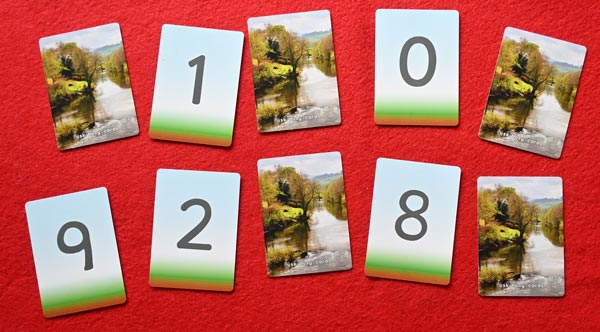
Shuffle and deal out the ten Usk digit cards, so that five them are placed face down.
A youngster might guess at the unknown digits. That technique requires the 'already chosen' digits to be remembered.
With more maturity and thought – maybe after several daily trials – digit '3' might be chosen – with certainy – as the first 'unknown'. On discovery of this system '4','5','6','7' should follow in fairly quick succession.
For the younger child the numbers could be laid-out in a left-right line of increasing size. Even if the child can automatically count, orally, from one to nine, the practice at thinking about such a prblem, with cards, is a new and useful practical experience.